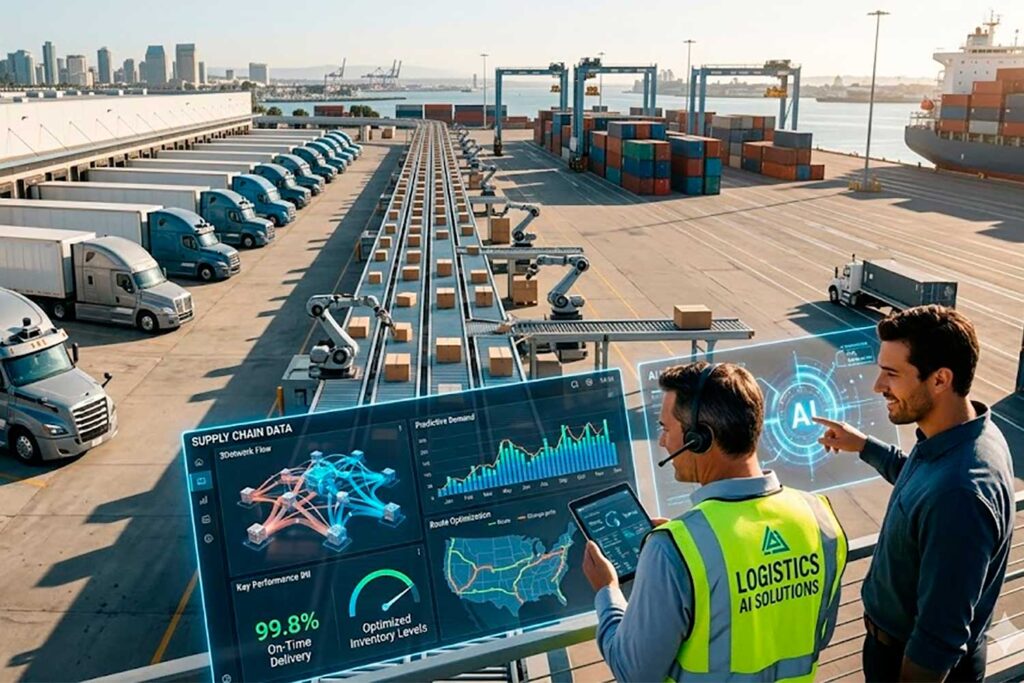
Your supply chain is bleeding money, and you might not even realize it. Overstocked warehouses, delayed shipments, inaccurate demand forecasts, and inefficient routing patterns cost American businesses billions annually. According to the Council of Supply Chain Management Professionals, logistics costs alone represent nearly 8% of U.S. GDP. For most companies, supply chain inefficiencies directly erode profit margins and competitive positioning.
The good news? Artificial intelligence solutions are revolutionizing how businesses plan, execute, and optimize their supply chain operations. From predictive demand forecasting to dynamic route optimization, AI-driven automation delivers measurable improvements in fulfillment performance while reducing operational costs. But implementing these technologies requires strategic expertise—cutting corners with inexperienced providers or discount solutions typically creates more problems than it solves.
This guide explores how AI solutions transform supply chain planning and fulfillment, what business owners need to know before implementation, and why partnering with an experienced web development agency makes the difference between transformative success and costly failure.
Understanding AI-Driven Supply Chain Optimization
Traditional supply chain management relies heavily on historical data, manual analysis, and reactive decision-making. When demand spikes unexpectedly or disruptions occur, businesses scramble to respond, often incurring rush shipping costs, lost sales, or excess inventory expenses.
AI solutions fundamentally change this paradigm by processing vast datasets in real-time, identifying patterns humans cannot detect, and making proactive recommendations before problems emerge. Machine learning algorithms continuously improve their accuracy, adapting to seasonal fluctuations, market trends, and emerging disruptions.
Core AI Capabilities in Supply Chain Management
Predictive Demand Forecasting AI analyzes historical sales data, market trends, weather patterns, social media sentiment, economic indicators, and dozens of other variables to predict future demand with remarkable accuracy. The U.S. Department of Commerce has documented how businesses using advanced forecasting reduce inventory costs by up to 20-30% while simultaneously improving product availability.
Intelligent Inventory Optimization Rather than relying on static reorder points, AI systems dynamically adjust inventory levels based on predicted demand, lead times, storage costs, and working capital considerations. This customer focus ensures products are available when buyers need them without tying up excessive capital in slow-moving stock.
Dynamic Route and Load Optimization Transportation represents one of the largest supply chain expenses. AI-powered routing systems consider traffic patterns, delivery windows, vehicle capacity, fuel costs, and driver schedules to create optimal delivery routes that reduce mileage and improve on-time performance.
Supplier Performance Analysis AI monitors supplier reliability, quality metrics, delivery performance, and risk factors to identify the best partners and flag potential problems before they disrupt operations. This automation eliminates the manual effort required to track dozens or hundreds of supplier relationships.
Warehouse Operations Enhancement From optimizing picking routes to predicting equipment maintenance needs, AI improves warehouse efficiency across multiple dimensions. Automated systems can determine optimal product placement, workforce scheduling, and quality control processes.
Measurable Business Benefits That Impact Your Bottom Line
Smart business owners demand tangible returns on technology investments. AI-driven supply chain solutions deliver quantifiable improvements across key performance indicators that directly affect profitability and competitive positioning.
Cost Reduction Across Multiple Categories
Inventory Carrying Costs The Federal Reserve reports that U.S. businesses hold approximately $2.3 trillion in inventory at any given time. Even modest reductions in inventory levels through better forecasting can free up significant working capital. Businesses implementing AI solutions often reduce safety stock requirements while maintaining or improving service levels.
Transportation and Logistics Expenses Route optimization, load consolidation, and carrier selection algorithms reduce fuel consumption, vehicle wear, and labor hours. Companies report transportation cost reductions of up to 15-25% after implementing sophisticated AI routing systems.
Waste and Obsolescence Better demand forecasting means fewer products expire, become obsolete, or require deep discounting. For businesses dealing with perishable goods or fast-changing product lines, this alone can justify the AI investment.
Revenue Enhancement Opportunities
Improved Product Availability According to research from the National Retail Federation, stockouts cost U.S. retailers over $1 trillion annually in lost sales. AI-driven inventory optimization ensures high-demand products remain available, capturing sales that would otherwise go to competitors.
Faster Order Fulfillment Modern customers expect rapid delivery. AI systems enable same-day or next-day fulfillment by optimizing inventory placement and routing. The U.S. Census Bureau confirms that e-commerce continues growing at double-digit rates, making fulfillment speed increasingly critical for competitive success.
Enhanced Customer Experience Accurate delivery estimates, proactive exception notifications, and reliable service build customer loyalty. This customer focus translates directly into higher lifetime value and repeat purchase rates.
Competitive Advantages in Dynamic Markets
Speed and flexibility separate market leaders from followers. AI solutions enable businesses to respond rapidly to market changes, competitor actions, and emerging opportunities. When supply chain disruptions occur—as demonstrated dramatically during recent global events—companies with advanced AI capabilities recover faster and maintain customer relationships that competitors lose.
The Small Business Administration emphasizes that operational efficiency creates sustainable competitive advantages that are difficult for competitors to replicate. AI-driven supply chain excellence becomes a strategic differentiator, not just an operational improvement.
Implementation Roadmap: From Assessment to Optimization
Successful AI implementation requires systematic planning and execution. Rushing the process or skipping critical steps typically results in underperforming systems that fail to deliver promised benefits.
Step 1: Current State Assessment and Goal Definition
Before implementing any AI solution, thoroughly document your current supply chain processes, pain points, and performance metrics. Identify specific, measurable goals such as reducing inventory levels by a certain percentage, improving on-time delivery rates, or decreasing transportation costs.
Engage stakeholders across your organization—operations, finance, sales, and customer service all have valuable perspectives on supply chain performance. This collaborative approach ensures the AI solution addresses real business needs rather than implementing technology for technology’s sake.
Step 2: Data Infrastructure Evaluation
AI systems are only as good as the data they process. Assess your current data collection, storage, and quality. Do you have accurate historical demand data? Can you track inventory movements in real-time? Is supplier performance documented systematically?
Many businesses discover that data infrastructure improvements are necessary before AI implementation. While this may seem like an obstacle, establishing robust data foundations delivers benefits beyond AI and prevents costly implementation failures.
Step 3: Solution Selection and Vendor Evaluation
The AI solutions market includes everything from simple forecasting tools to comprehensive enterprise platforms. Your business needs, budget, and technical capabilities should drive selection decisions.
Critical evaluation criteria include:
Integration Capabilities The AI system must connect seamlessly with your existing ERP, WMS, TMS, and e-commerce platforms. Poor integration leads to data silos and manual workarounds that undermine efficiency gains.
Scalability Choose solutions that grow with your business. A system that works for current volumes but cannot handle growth becomes a liability rather than an asset.
Vendor Experience and Support Implementation expertise matters enormously. Vendors with proven track records in your industry understand unique challenges and can navigate complexities that generalist providers miss. Quality services require investment in skilled personnel, ongoing support, and continuous improvement—factors that make truly cheap solutions impossible.
Customization Options Every business has unique processes and requirements. Cookie-cutter solutions rarely deliver optimal results. Look for platforms that allow configuration and customization to match your specific operational needs.
Step 4: Pilot Implementation and Testing
Rather than attempting enterprise-wide implementation immediately, start with a focused pilot project. Select a specific product category, geographic region, or operational process where success can be clearly measured.
Pilot projects allow your team to learn the system, identify integration issues, and refine processes before full-scale deployment. They also generate internal success stories that build organizational support for broader implementation.
Step 5: Training and Change Management
Technology alone does not transform operations—people must understand and embrace new systems. Comprehensive training ensures your team can effectively use AI tools and interpret their recommendations.
Change management involves communicating why new systems are being implemented, how they benefit both the company and individual employees, and what support is available during the transition. Resistance to change derails many technology initiatives; proactive change management significantly improves success rates.
Step 6: Continuous Monitoring and Optimization
AI systems require ongoing monitoring, tuning, and enhancement. Machine learning models must be periodically retrained with new data. Business rules may need adjustment as conditions change. Performance metrics should be tracked consistently to ensure systems deliver expected benefits.
Establish clear ownership for AI system management within your organization. Whether handled internally or through an ongoing partnership with your implementation provider, continuous optimization separates good results from exceptional performance.
Common Pitfalls and How to Avoid Them
Even well-intentioned AI initiatives encounter challenges. Understanding common pitfalls helps you avoid expensive mistakes and implementation delays.
Underestimating Data Quality Requirements
AI algorithms cannot compensate for fundamentally flawed data. Garbage in, garbage out remains true regardless of how sophisticated the technology. Businesses sometimes discover that years of inconsistent data entry, incomplete records, or disconnected systems must be addressed before AI can function effectively.
The solution: Allocate sufficient time and resources to data cleansing and validation before system deployment. This upfront investment pays dividends throughout the AI lifecycle.
Choosing Solutions Based Solely on Price
Quality AI implementation requires experienced developers, sophisticated algorithms, robust infrastructure, and ongoing support. Providers offering dramatically lower prices than competitors typically cut corners in areas that matter—expertise, customization, support, or underlying technology quality.
As the U.S. Federal Trade Commission reminds businesses, if a deal seems too good to be true, it usually is. Experienced professionals command appropriate compensation because they deliver reliable results and prevent costly failures. The lowest-priced option frequently becomes the most expensive when factoring in implementation delays, system failures, and lost opportunity costs.
Neglecting Integration Complexity
Supply chain AI does not operate in isolation—it must exchange data with procurement systems, warehouse management platforms, transportation management software, and customer-facing applications. Integration complexity often exceeds initial estimates, particularly for businesses with legacy systems or custom applications.
Work with a web development agency that has demonstrated integration expertise. Their experience navigating API connections, data mapping, and system synchronization prevents the integration nightmares that plague many projects.
Setting Unrealistic Expectations
While AI delivers impressive results, it is not magic. Expect a learning curve as systems accumulate data and algorithms refine predictions. Initial forecasts may not dramatically outperform existing methods, but accuracy improves over time as the system learns your business patterns.
Communicate realistic timelines and expectations to stakeholders. Quick wins are possible, but transformative results typically emerge over months, not weeks.
Ignoring Organizational Change Requirements
New systems change how people work. Procurement teams may resist AI-generated order recommendations. Warehouse managers might distrust automated slotting decisions. Transportation coordinators could question AI routing suggestions.
Successful implementation includes demonstrating AI value to users, providing adequate training, and creating feedback mechanisms where employees can identify issues and suggest improvements. Automation should augment human expertise, not replace human judgment entirely.
Industry-Specific Applications and Considerations
While AI principles apply across sectors, implementation details vary by industry. Understanding sector-specific considerations helps tailor solutions to your business reality.
Retail and E-Commerce
The U.S. Department of Commerce reports that e-commerce accounts for approximately 15% of total retail sales and continues growing rapidly. Retail supply chains face unique challenges including highly seasonal demand, fashion trends, product proliferation, and omnichannel complexity.
AI solutions for retail focus heavily on demand forecasting across thousands of SKUs, optimal inventory distribution across stores and distribution centers, and dynamic pricing strategies that balance margin and velocity. Customer focus drives requirements for rapid fulfillment and flexible return processing.
Manufacturing
Manufacturers balance production planning, raw material procurement, work-in-progress inventory, and finished goods distribution. AI optimizes production schedules based on demand forecasts, minimizes changeover costs, and ensures component availability without excess inventory.
The Bureau of Labor Statistics notes that manufacturing productivity gains directly impact U.S. economic competitiveness. AI-driven supply chain excellence enables manufacturers to compete effectively against low-cost international competitors.
Healthcare and Pharmaceuticals
Healthcare supply chains involve strict regulatory compliance, temperature-controlled logistics, expiration date management, and critical product availability requirements. The Food and Drug Administration mandates extensive documentation and traceability.
AI systems designed for healthcare must incorporate these regulatory requirements while optimizing inventory levels for expensive pharmaceuticals, medical devices, and supplies. Stockouts in healthcare can literally cost lives, making reliability paramount.
Food and Beverage
Perishability creates unique supply chain pressures in food and beverage industries. AI forecasting must account for shelf life, temperature requirements, and seasonal demand variations. The U.S. Department of Agriculture estimates that up to 30-40% of the food supply is wasted—AI optimization can significantly reduce this waste while improving profitability.
Distribution and Wholesale
Distributors and wholesalers operate complex networks serving diverse customer bases with varied product mixes. AI solutions optimize warehouse slotting, order picking sequences, delivery routing, and customer service level management.
The National Association of Wholesaler-Distributors emphasizes that operational efficiency separates successful distributors from struggling competitors in increasingly competitive markets.
Measuring ROI and Demonstrating Value
Business owners rightfully demand accountability for technology investments. Effective AI implementations include clear metrics and regular reporting that demonstrate value creation.
Key Performance Indicators to Track
Inventory Turnover Ratio Measures how efficiently inventory is utilized. Higher turnover indicates less capital tied up in stock and better cash flow management.
Order Fulfillment Accuracy Tracks the percentage of orders shipped complete and correct. AI-driven systems typically improve accuracy while reducing manual checking requirements.
On-Time Delivery Performance Monitors percentage of deliveries meeting customer-expected dates. Improved forecasting and routing optimization directly enhance this metric.
Supply Chain Costs as Percentage of Revenue Comprehensive measure of overall supply chain efficiency. AI implementations should drive this percentage downward over time.
Forecast Accuracy Compares predicted demand to actual sales. Improving forecast accuracy indicates the AI system is learning and adapting effectively.
Working Capital Requirements Tracks total capital invested in inventory and receivables. Efficient supply chains minimize working capital needs, freeing resources for growth investments.
Calculating Total Cost of Ownership
When evaluating AI investments, consider total cost of ownership including software licensing, implementation services, integration development, training, ongoing support, and internal resources required for system management.
Compare these costs against quantifiable benefits such as inventory reduction, transportation savings, labor efficiency, and revenue improvements from better product availability. Most businesses find that well-implemented AI solutions generate positive ROI within 12-24 months, with accelerating benefits in subsequent years.
The Critical Role of Expert Implementation Partners
AI supply chain optimization represents significant opportunity, but implementation complexity demands experienced guidance. Attempting DIY approaches or engaging inexperienced providers typically results in disappointing outcomes.
Why Web Development Agency Expertise Matters
Technical Integration Skills Modern supply chains involve multiple software platforms, each with unique APIs, data structures, and integration requirements. Experienced web development agencies understand these complexities and architect solutions that work reliably across your technology ecosystem.
Industry Knowledge Developers who have implemented AI solutions across multiple clients and industries bring valuable perspective on what works, what fails, and how to adapt best practices to your specific situation. This accumulated knowledge accelerates implementation and avoids common pitfalls.
Customization Capabilities Off-the-shelf AI solutions rarely address every business requirement. Expert agencies can customize algorithms, develop unique integrations, and create reporting tools that match your exact needs rather than forcing your processes into rigid software constraints.
Ongoing Optimization Support AI systems require continuous refinement as business conditions evolve. Established agencies provide ongoing support, system updates, and optimization services that keep your solution performing at peak effectiveness.
Risk Mitigation Experienced professionals identify potential problems before they occur, architect systems with appropriate redundancy and failover capabilities, and ensure data security meets regulatory requirements. The value of avoiding implementation failures and security breaches far exceeds the cost difference between expert and novice providers.
Questions to Ask Potential Implementation Partners
When evaluating agencies, dig deep into their specific experience:
What supply chain AI projects have you completed in our industry? Can you provide references from similar businesses? How do you approach data quality assessment? What is your integration methodology? How do you handle change management and user training? What ongoing support and optimization services do you provide?
Agencies with genuine expertise welcome detailed questions and provide substantive answers. Vague responses or reluctance to discuss specifics should raise red flags.
Future Trends Shaping AI Supply Chain Solutions
Technology evolution continues accelerating. Understanding emerging trends helps ensure your AI investment remains relevant and competitive.
Advanced Machine Learning and Deep Learning
Current AI systems primarily use established machine learning techniques. Emerging deep learning approaches promise even greater accuracy in demand forecasting, anomaly detection, and optimization. These advanced algorithms can identify subtle patterns and relationships that traditional methods miss.
Internet of Things Integration
The proliferation of connected sensors, RFID tags, and tracking devices generates unprecedented supply chain visibility. AI systems that incorporate real-time IoT data can respond to emerging situations faster and more accurately than systems relying on delayed or aggregated information.
Autonomous Vehicles and Drones
While still emerging, autonomous delivery vehicles and drones will eventually transform last-mile logistics. AI systems must evolve to optimize hybrid delivery networks combining traditional vehicles with autonomous options.
Blockchain for Supply Chain Transparency
Blockchain technology offers enhanced traceability and authentication across complex supply networks. Integration between AI optimization systems and blockchain transparency platforms will create new capabilities for businesses requiring rigorous provenance documentation.
Sustainability Optimization
Environmental considerations increasingly influence supply chain decisions. Future AI systems will optimize not just cost and service but also carbon footprint, packaging waste, and other sustainability metrics that matter to both regulators and environmentally conscious customers.
The U.S. Environmental Protection Agency encourages businesses to adopt sustainable supply chain practices. AI makes it possible to pursue environmental goals without sacrificing economic performance.
Taking Action: Your Path to Supply Chain Excellence
Supply chain optimization through AI represents one of the most significant opportunities for businesses seeking competitive advantage in today’s market. The technology has matured beyond early-adopter experiments into proven solutions delivering measurable business value.
However, success requires more than purchasing software. Strategic planning, expert implementation, quality data infrastructure, effective change management, and ongoing optimization all contribute to outcomes. Businesses that approach AI thoughtfully, partner with experienced professionals, and commit to continuous improvement achieve transformative results. Those that rush implementation, choose providers based solely on price, or underestimate complexity often struggle with disappointing performance and wasted investment.
The difference between success and failure frequently comes down to implementation partner selection. Experienced web development agencies bring technical expertise, industry knowledge, proven methodologies, and ongoing support that generic software vendors cannot match. Yes, quality services cost more than bargain alternatives—but they also deliver reliable results, avoid expensive failures, and generate sustained competitive advantages.
Your supply chain either creates competitive advantage or surrenders opportunities to more efficient competitors. The question is not whether to pursue AI-driven optimization but how quickly you can implement it effectively.
If you are ready to transform your supply chain performance, reduce operational costs, and improve customer satisfaction through intelligent automation, our team brings the expertise and experience your business deserves. We have successfully implemented AI solutions across diverse industries, understand the complexities of modern supply chains, and deliver results that justify investment. Request a no-obligation quote today to discuss how our web development agency can design and implement AI-driven supply chain solutions tailored to your specific business needs, challenges, and goals. Let’s build the efficient, responsive, profitable supply chain your business needs to thrive in an increasingly competitive marketplace.